‘Expensive wrong’: Cambridge debates $60M ION reimbursement
Posted Feb 4, 2026 07:41:49 AM.
Last Updated Feb 4, 2026 09:21:18 AM.
Councillors in Cambridge had heated discussions around what benefits the city has seen from the planned ION expansion, and whether it should request a $60 million reimbursement from the region.
It stemmed from a motion tabled at council back in December, one that would send a direct request to the Region of Waterloo for the $60 million refund, saying that the costs have been unevenly distributed between Kitchener, Cambridge and Waterloo.
It was brought forward by councillors Helen Schwery and Adam Cooper, back in the discussion during the latest meeting on Feb. 3, with Cooper saying Kitchener and Waterloo have been seeing all the progress, while Cambridge is still years away from any benefits.
“Cambridge does not currently receive LRT service, yet we have been required to contribute financially,” Cooper stated. “Surrounding townships also do not receive service, but have not been required to pay toward its capital costs and operations. Municipalities that receive equal levels of service should be treated equally. We are not.”
The motion would also request a full breakdown of exactly what taxpayers in the city had been spending so far on the LRT expansion towards ION Stage 1 and Stage 2, and ask the region to reimburse Cambridge for the costs it had incurred.
Cooper did say that he doesn’t want to see an end to the project, but wants some equity for the developments that each portion of the region has seen so far.
Councillor Nicholas Ermeta agreed with Cooper, saying that it’s all about putting each municipality on the same level when it comes to the costs versus benefits of the project.
“A lot of money has left this city, and I think we’re at a disadvantage for that reason,” Ermeta said. “This does level the playing field. It does put the city on a more equal level than what we have, than where we are right now.
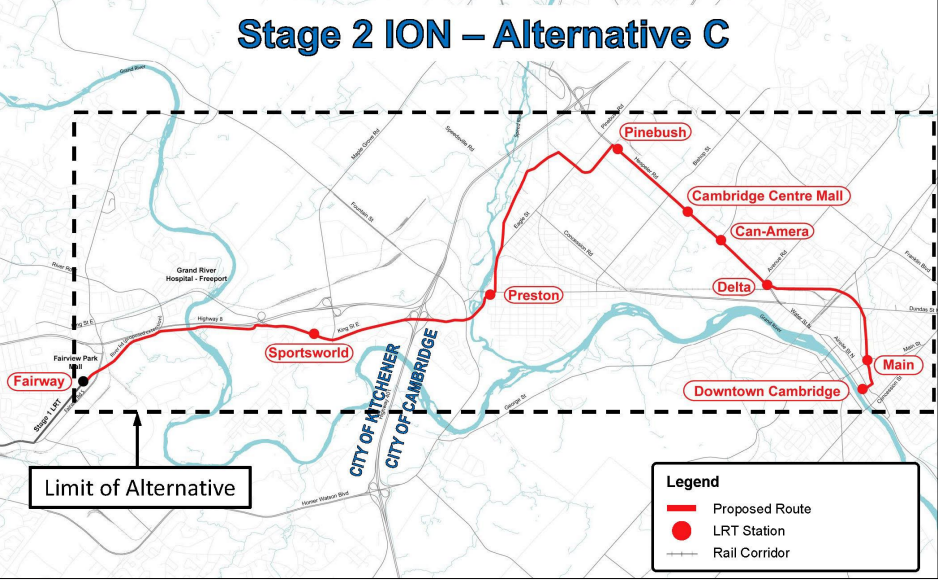
As of now, Cambridge has contributed towards the construction of ION Stage 1 and progression towards Stage 2, as well as the ongoing operating costs of the LRT, even though it currently only runs through Kitchener and Cambridge. The planned expansion would add a 17-kilometre route from Fairview Mall into Downtown Galt.
The motion led to plenty of discussion around the horseshoe, as not everyone was in agreement with the comments the motion had made, including Councillor Coery Kimpson. She said the city had an obligation to honour the commitments the city had previously made when it comes to LRT in Cambridge.
“We need to respect the decisions that were made by the previous council,” said Kimpson. “This was a decision that was made by the elected council of the day, following due process.”
Councillor Scott Hamilton agreed with the sentiment of Kimpson. He said that a request of that nature to the region may not be the right approach.
“I don’t feel like the motion is legal. I don’t feel like it’s enforceable,” said Hamilton. “I don’t feel like it paints a proper picture to our residents to say that we can go and solicit funds from other levels of government. It’s in our strategic plan that the LRT is in the future vision of the city.”

That point was approached by Cambridge Mayor Jan Liggett, who sided with the motion and took issue with the phrasing that Hamilton and other councillors used around the legality of such a request to the region.
“First off, it is legal. Definitely legal. I don’t think we should say something is illegal when we wouldn’t be putting it through as a motion if it were illegal,” said Liggett. “I’m going to support the motion. I think it tells the public that they have been paying for a number of years for something we have not been getting, and by the time that next phase of the LRT comes in, we will have been paying still for another 10, 15 years for something we are not getting.”
The discussions were split, with Councillor Sheri Roberts siding against the motion, echoing the remarks of Hamilton and Kimpson.
“Our focus should really be on advocating constructively for timely delivery, physical responsibility and fair service for our residents, not on trying to unwind a regional funding model that all lower-tier municipalities operate within.”
Ultimately, when the vote on the motion was introduced, it was voted against and shot down by a margin of a single vote, being defeated 5 to 4.
It means no requests for reimbursement will be headed towards the regional horseshoe, with plans and payments continuing as previously for the City of Cambridge and its push towards LRT.