Vehicle or mobility device? Growing safety concern for local accessibility advocate
Posted Aug 28, 2025 03:27:05 PM.
Last Updated Aug 29, 2025 07:53:27 AM.
As the popularity of enclosed mobility devices grow, a Cambridge father is ringing alarm bells that they pose a danger to pedestrians and take advantage of regulations meant to increase accessibility for those with mobility issues.
Devin Sisak is the founder of Barrier-free Cambridge and is the father of a son who uses a wheelchair. He has highlighted an issue he believes is a public safety matter: the use of enclosed mobility devices on city sidewalks and multi-use paths.
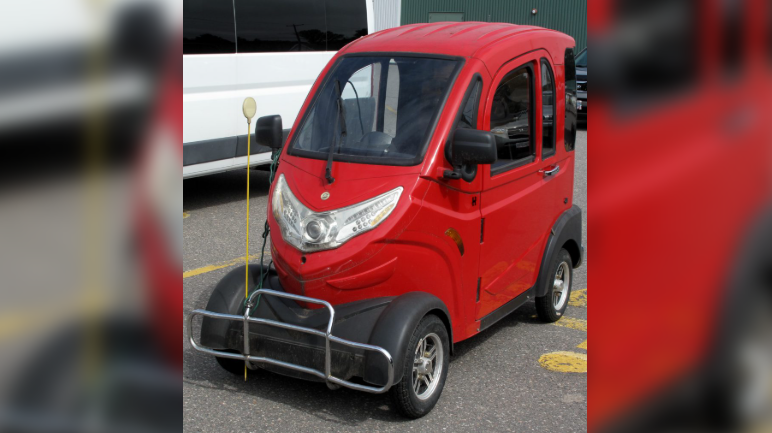
They look like a smaller version of a smart-car and often have many of the same amenities, yet they are still allowed in spaces normally reserved for pedestrians, cyclists and users of more traditional mobility aids.
Sisak was a guest on The Mike Farwell Show and highlighted how these so-called “mobility devices” have heat and air conditioning, doors with rolldown windows and almost always a passenger seat.
He said municipalities and the province need to look at how these vehicles are classified.
“Some of these can fit up to four people, most are being sold have two seats.” said Sisak. “As soon as you can drive with your friends it’s no longer a mobility device, it’s a vehicle.”
Sisak also mentioned that some models can reach speeds in excess of 40 km/h, far greater than that of an electric wheelchair or scooter. He believes the way enclosed mobility devices are being marketed is a major part of the problem.
“The province in 2017, brought in a pilot project for low-speed electric vehicles. Municipalities have to opt in to have them allowed to drive on their roads. And, it seems that dealers are labelling them as mobility devices to get around those bylaws.”
Sisak went on to say how he’s observed some marketing trying to target people who have lost their driving privileges.
“We have these checks and balances to keep people safe. Not only pedestrians, the drivers, the users themselves. I really question, if you’re losing your license for a reason, why are we just giving you a smaller car and that’s okay.”
In a response to an email from 570 NewsRadio, the City of Cambridge said:
“At this time, enclosed mobility devices are not permitted on City sidewalks; however, other mobility assistive devices such as motorized wheelchairs are. The City’s priority is safety for both those who use devices and others using sidewalks and pathways. We review unique cases individually and continue to monitor practices in other municipalities.”
570 NewsRadio reached out to Waterloo Regional Police also responded with a statement:
“The enclosed mobility scooter is considered a pedestrian device. In many cases, it is permitted on the sidewalks, much like a scooter. However, different municipalities may have different bylaws that outline those rules. In the event there are no sidewalks, they may be permitted to use the shoulder of the roadway as long as they continue to follow the rules of the road.”
Sisak wants to see regulations that would prevent enclosed mobility devices from being classified in the same category as motorized wheelchairs or other mobility aids, before someone gets hurt.