Region’s human trafficking cases nearly triple national average: WRPS

Posted Feb 23, 2026 07:43:39 AM.
Last Updated Feb 23, 2026 11:18:47 AM.
New figures released by Waterloo Regional Police Service (WRPS point to a stark trend in human trafficking cases in the region, now nearly tripling the national average.
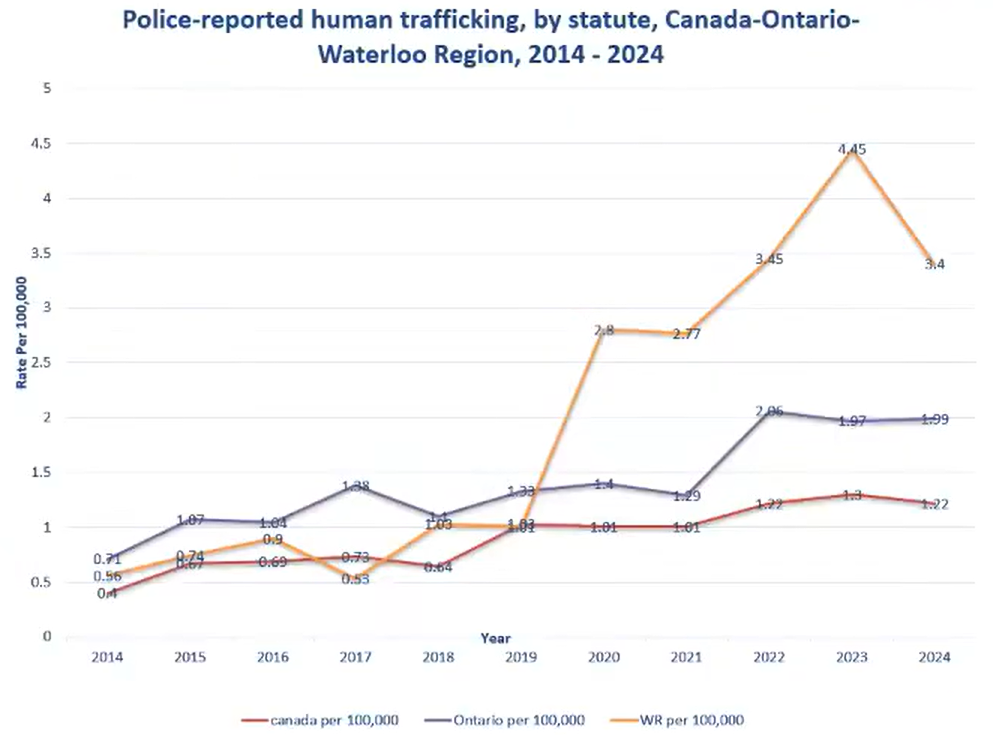
The numbers stem from a recent WRPS board meeting, which went into detail on the rising trend of human trafficking cases across the municipality, showing rises since 2020, but climbing at a greater rate over the past three years.
It shows that the provincial average sat at 1.99 reports per 100,000 people in 2024, the national average sat lower at 1.22, but Waterloo Region currently sits at 3.4. That’s 70 per cent higher than the listed provincial average and 178 per cent higher than the national figure.
“I can only imagine the stuff that is not reported or caught, how that looks like and how that adds to this,” said WRPS board member Tony Giovinazzo. “The most horrific number amongst all that, and they’re all bad, is the common age for a girl; 13 years of age,” pointing to the national average for girls who are trafficked.
While the updated national and provincial numbers haven’t been registered yet for 2025, they still paint a grim picture for the trend Waterloo Region has seen when it comes to cases of human trafficking.
That exponential growth can really be seen since 2023, with police figures showing 69 reported occurrences, climbing to 87 cases in 2024, and rising further to 131 in 2025.
That number only increases when prostitution, which is another form of human trafficking, is included, bringing that number for 2025 up to 205.
In its report, WRPS pointed to two key contributors to the region’s heightened police-reported numbers, the first of which is centred around support partnerships and programs allowing for better tracking.
The second is focused on the region’s accessible location within southern Ontario.
“We know through our highway corridor, as a large municipality within Canada, this is a focal point of opportunity for human trafficking to take hold and to occur,” said Chief Mark Crowell with WRPS.
While the number of cases has been climbing in recent years, the total number of charges from regional police has not kept pace. In 2025, WRPS laid a total of 27 charges involving 14 different victims.
That brings the service’s charge rate to 13.2 per cent, which is slightly above the national average of around 10 per cent.
“These are among the most complex criminal investigations that might occur because of the vulnerabilities, the psychological impacts, the level of risks, and danger for victims,” said Chief Crowell. “When we look at our interventions, the charges laid, and leading to successful prosecutions, those are measures of success.”
Crowell continued to say that there is an issue when it comes to reporting within both the region and across Canada as a whole, as “there’s an ecosystem of criminal enterprise and opportunity that swirls around and involves human trafficking-related behaviour, connected to so many forms of organized crime.”
“Sometimes the reluctance, the fear, and the oppressive nature of human trafficking really leave victims and survivors so vulnerable that we require information to come through many angles, and then we launch our investigations,” Crowell stated.

He pointed towards the main ways WRPS sees the reports come forward, including victim reporting, supportive agencies, and tips from the general public.
WRPS said it’s focused on finding further supports and programs that will help in bringing those trafficking numbers back in the right direction, saying it has already partnered with #NotInMyCity, a campaign to help push back against human trafficking.
“If there are any organizations out there who may be listening, we certainly would love to have their support as well because the more people who are educated on it, the more people who can help,” said Cherri Greeno, Director of Corporate Affairs with WRPS.
The service also said it has continued with an e-learning course for its officers and members, committing at the tail end of 2025 to have all members complete the course as part of their training.