Local UW start-up gets rolling on future robotic food delivery system
Posted Jun 11, 2025 10:28:30 AM.
Last Updated Jun 11, 2025 03:38:35 PM.
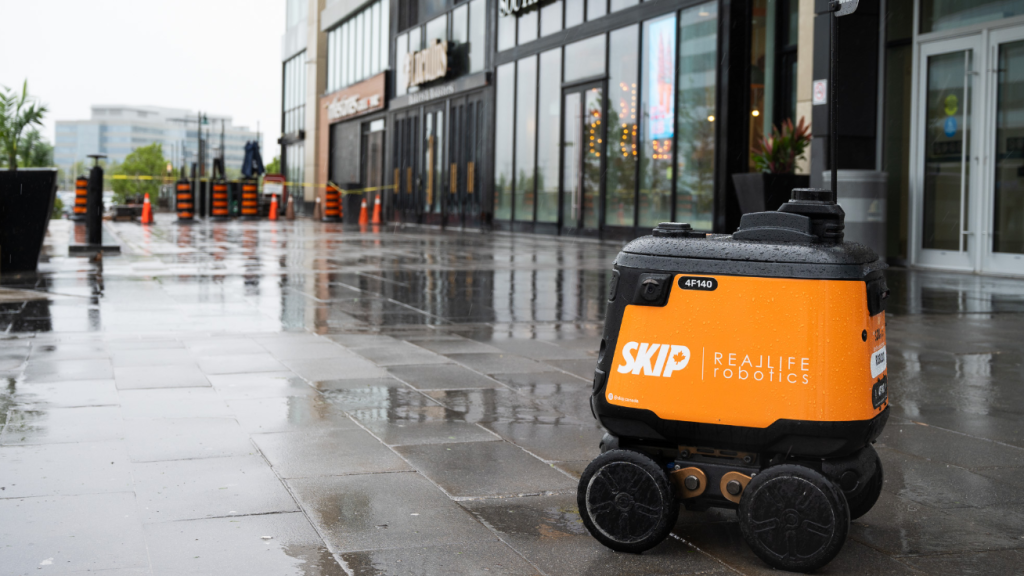
A start-up coming out of the University of Waterloo has begun a new pilot, with the hopes of bringing the future into sight for robotic food delivery.
It’s happening through Velocity-based Real Life Robotics, which has partnered with Skip, the Canadian online food delivery service.
The trial will be taking place in Markham, Ont., over a three-month span. Four robots will be rolling out to help make deliveries within a two-kilometre stretch of participating restaurants in the city.
The primary focus for the project is to test out the capabilities of the robotic systems in the real world, all with safety for people and the robot itself in mind.
“It has a suite of sensors that are on the robot right now, including a LIDAR that is used for obstacle avoidance. That’s one layer of safety in there,” Sharif Virani, Head of Growth with Real Life Robotics, said. “As well as the fact that every robot right now actually has a human in a loop, so there’s actually a human remote that jumps in whenever the robot is encountering a challenge, like crossing the street.”
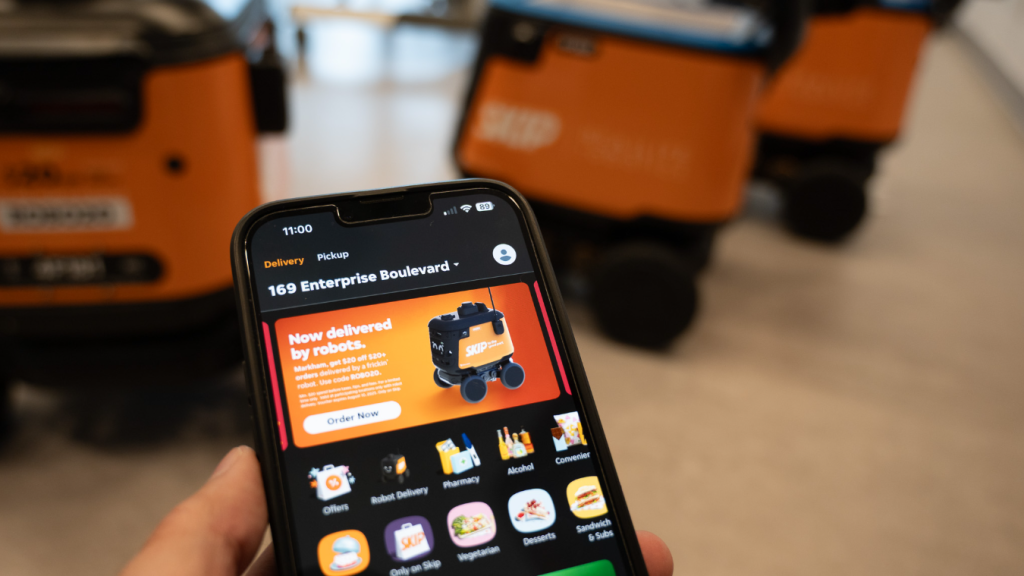
The system would see customers select “Robotic Delivery” when ordering food through the app.
The robot would then make the trek to the restaurant, pick up the food, roll out through sidewalks and cross city streets, before making its way to the customer, where they can simply unlock it with a QR code.
Virani mentioned that the end goal of the team would be to have the robots themselves operate completely autonomously, but with the system still in more of a testing phase through the trial, it’s not the main priority as of yet.
“It would definitely be part of the goal, but right now we’re still in a testing phase and learning about how they interact with different types of pedestrians and, you know, city obstacles and things like that. Those are all part of the process, and all those learnings are incorporated into the system to enhance that autonomy.”
Even with the robotic nature of the systems, Virani stated that it’s been important to make them as easy to work with as possible. That involves incorporating some elements into the design and system to make it as friendly as possible.
“The hardware and operations overall are designed with humans in mind, so we take a very human-centric approach to design. Part of that on the hardware side is ensuring the robot has a face that’s not just friendly, but emotive, and is able to interact with the community around it.
If the pilot is deemed as successful, Real Life Robotics said it hopes to ultimately roll out approximately 500 robotic systems nationwide across Canada, hoping to do so over the next three years.