Wilfrid Laurier University facing potential $180M budget shortfall by 2030

Posted Jul 8, 2025 06:56:56 AM.
Last Updated Jul 8, 2025 12:36:08 PM.
Wilfrid Laurier University’s budget for the 2025/26 school year unveils more financial struggles for academic institutions in Waterloo Region.
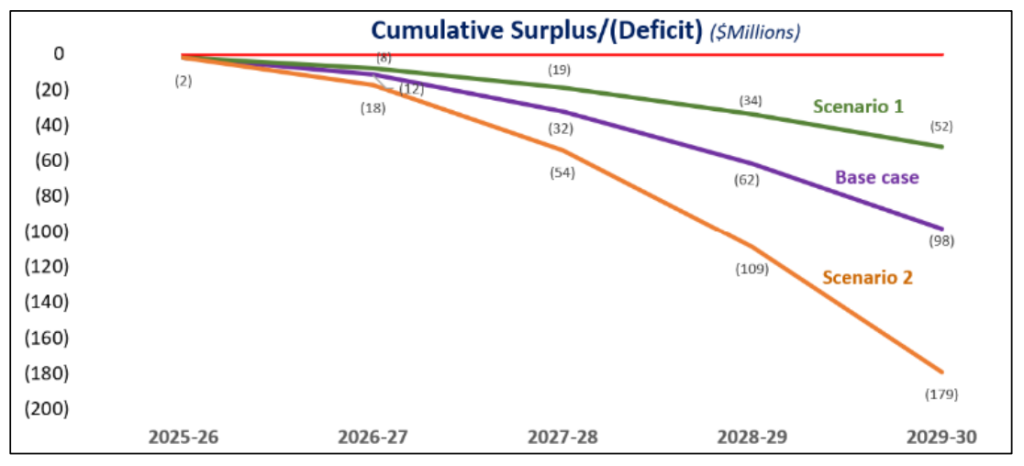
According to the report, the university is facing a snowballing budget deficit for each year until 2030, which, in its “worst case scenario” forecasting, adds up to a nearly $180 million cumulative shortfall.
“The limitations on revenue mean that Laurier will not be able to keep pace with rising operating costs, make the appropriate level of investments in facilities renewal and information technology systems, or invest in strategic initiatives and programs required to succeed in a highly competitive sector,” it reads.
Laurier points to a number of significant factors putting a strain on the amount of revenue its able to bring in.
First, the cap on international study permits, put in place by the federal government in 2024, has decreased the amount of revenue local academic institutions can bring in across the board. In April, Conestoga College laid off nearly 180 employees because of the challenges it faces due to the international student cap.
At Laurier, tuition fees for international students are roughly four times more expensive than those of their domestic classmates. The number of international students attending Laurier is set to drop by roughly 14 per cent in this coming year.
However, the university is also facing challenges when it comes to generating revenue from domestic student tuition fees.
The school points to a tuition freeze, put in place by the Ontario government, as another cause for its budget issues. The domestic undergraduate enrollment is projected to remain steady at just over 19,000 for the upcoming semester.
As for the numbers, the budget shortfall for the upcoming year is a modest $2.4 million, but that number is set to grow.
“On a scenario basis, a deficit is anticipated with growing magnitude in future years in all scenarios,” reads the report.
In the worst case scenario, that shortfall could grow to $15.3 million in 2026/27, $36.5 million in 2027/28, $54.5 million in 2028/29, and finally $70.5 million in 2029/30.
“Successfully navigating this difficult environment will require highly disciplined and effective financial management as the university considers both the short-term horizon as articulated in the fiscal year budget and long-term sustainability as depicted in the multi-year budget projections,” reads the report.